WorkPantun-AI
AI / NLP · 2026
Pantun-AI
“Teaching machines to read between the lines of Malay verse.”
Services
AI Solutions
Tech
PythonPyTorchMalayBERTTransformersscikit-learnNLP
Built by
Full case study →
Rahimi Rusyuddin
Sole author, pipeline design, model implementation, deployment
Personal research project. Accepted at AiDAS 2026, the 7th International Conference on Artificial Intelligence and Data Sciences.
Documentation

3
Ensemble models
~60%
MalayBERT macro F1
8
Pantun theme classes
3/3
Consensus on clear cases
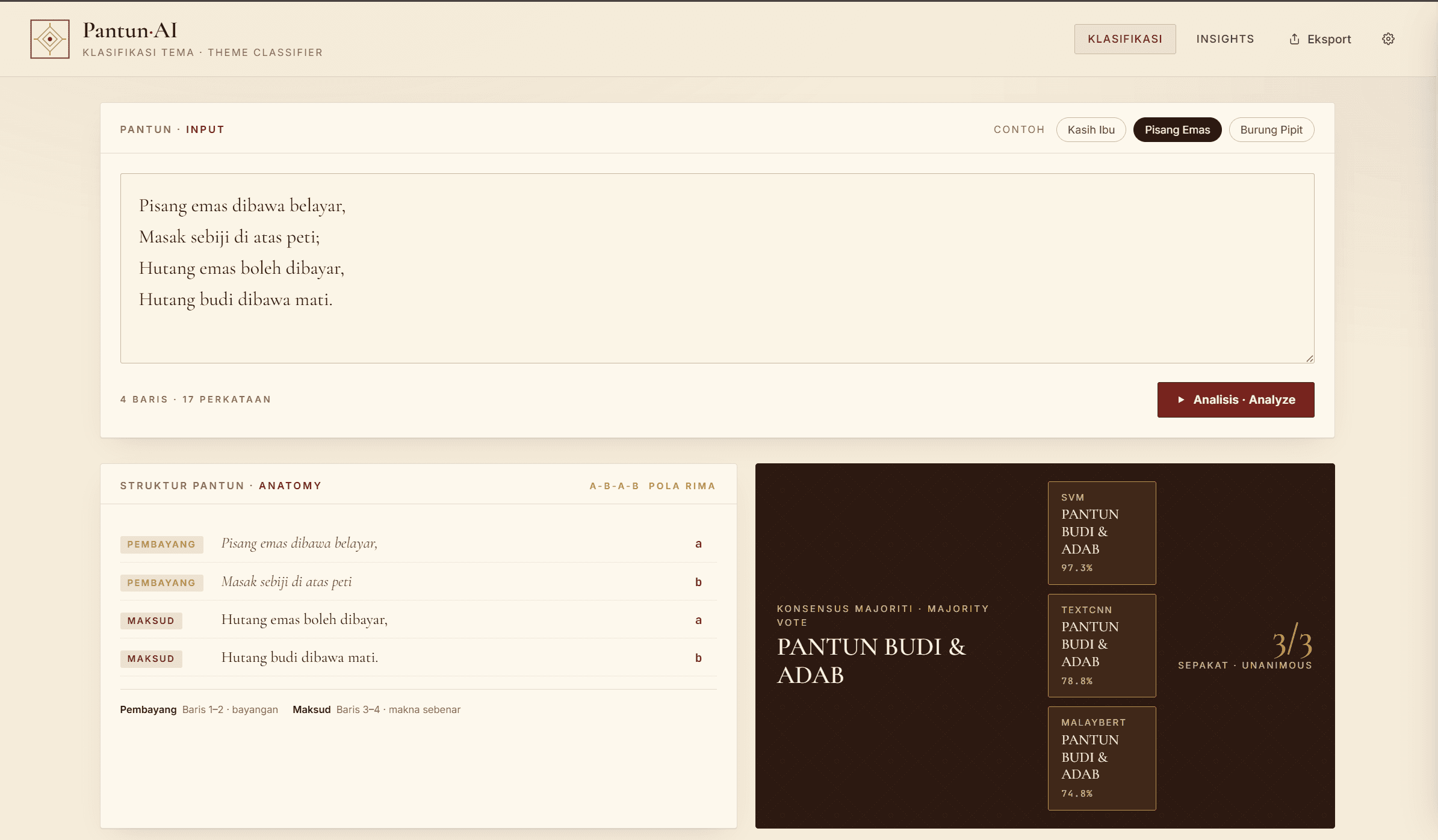
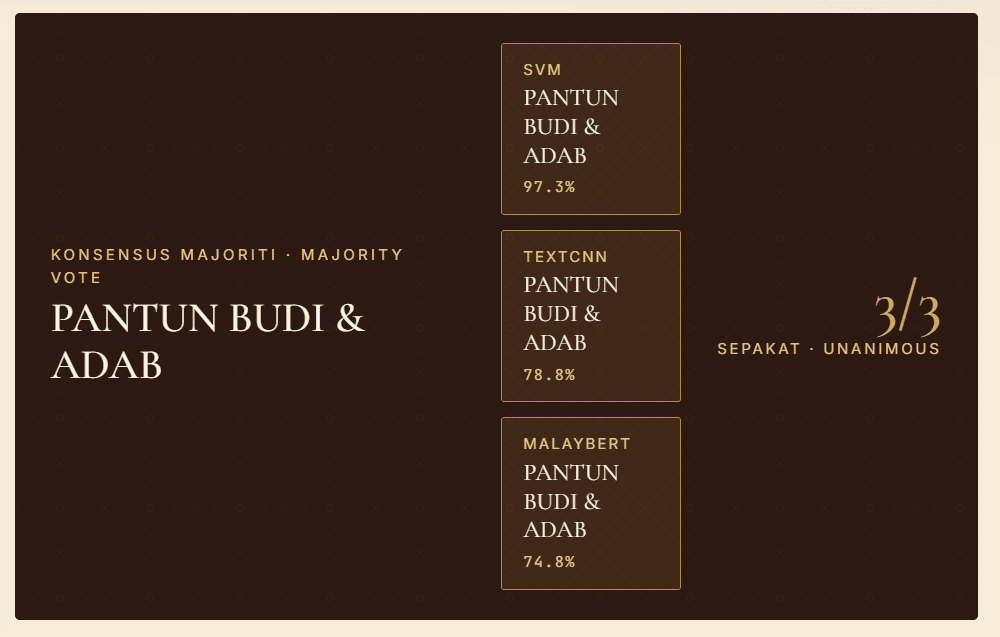
A Malay pantun theme classifier that runs three very different models (a fine-tuned MalayBERT transformer, a classic TF-IDF + SVM, and a TextCNN) side by side, then resolves their predictions through a majority vote to label the theme of any four-line pantun.
The Challenge
Malay pantun rarely states its meaning outright. The literal "pembayang" (foreshadow) and the figurative "maksud" (intent) often pull in different directions, so keyword matching collapses: a pantun mentioning "kasih" is not necessarily about love. Compounding this, the labelled dataset is small and badly imbalanced: some theme classes have only a few dozen samples, which punishes data-hungry models.
Our Solution
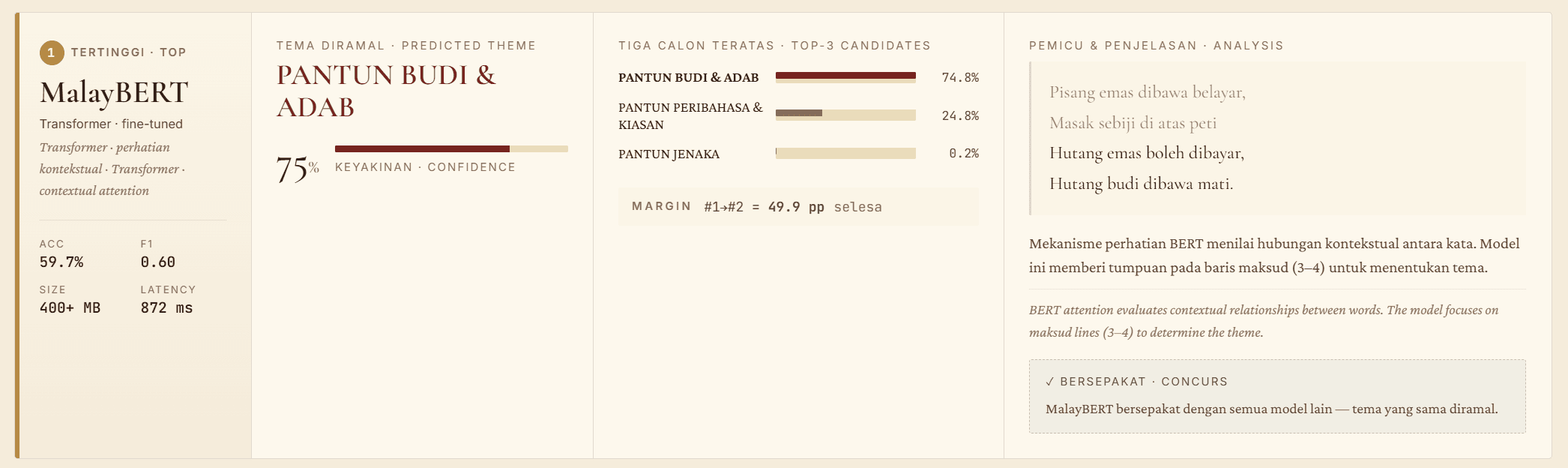
The ensemble plays each model to its strength. MalayBERT (mesolitica/bert-base-standard-bahasa-cased) reads whole-context meaning and figurative intent; the TF-IDF + SVM nails explicit keyword signals like "Tuhan" or "Budi"; TextCNN captures local n-gram patterns. A majority-vote layer surfaces a single consensus theme with per-model confidence, plus a pantun anatomy breakdown (A-B-A-B rhyme, pembayang vs. maksud) and related pantun suggestions.
The Outcome
MalayBERT led on nuance at ~60% macro F1, with SVM close behind (~55%) and TextCNN trailing (~47%), exactly as the data scarcity predicted. The transparent three-model view turns a black-box label into an explainable, teachable read of each verse, useful for students of classical Malay literature.
Full Tech Stack
PythonPyTorchTransformersMalayBERTscikit-learnTF-IDFTextCNNpandas